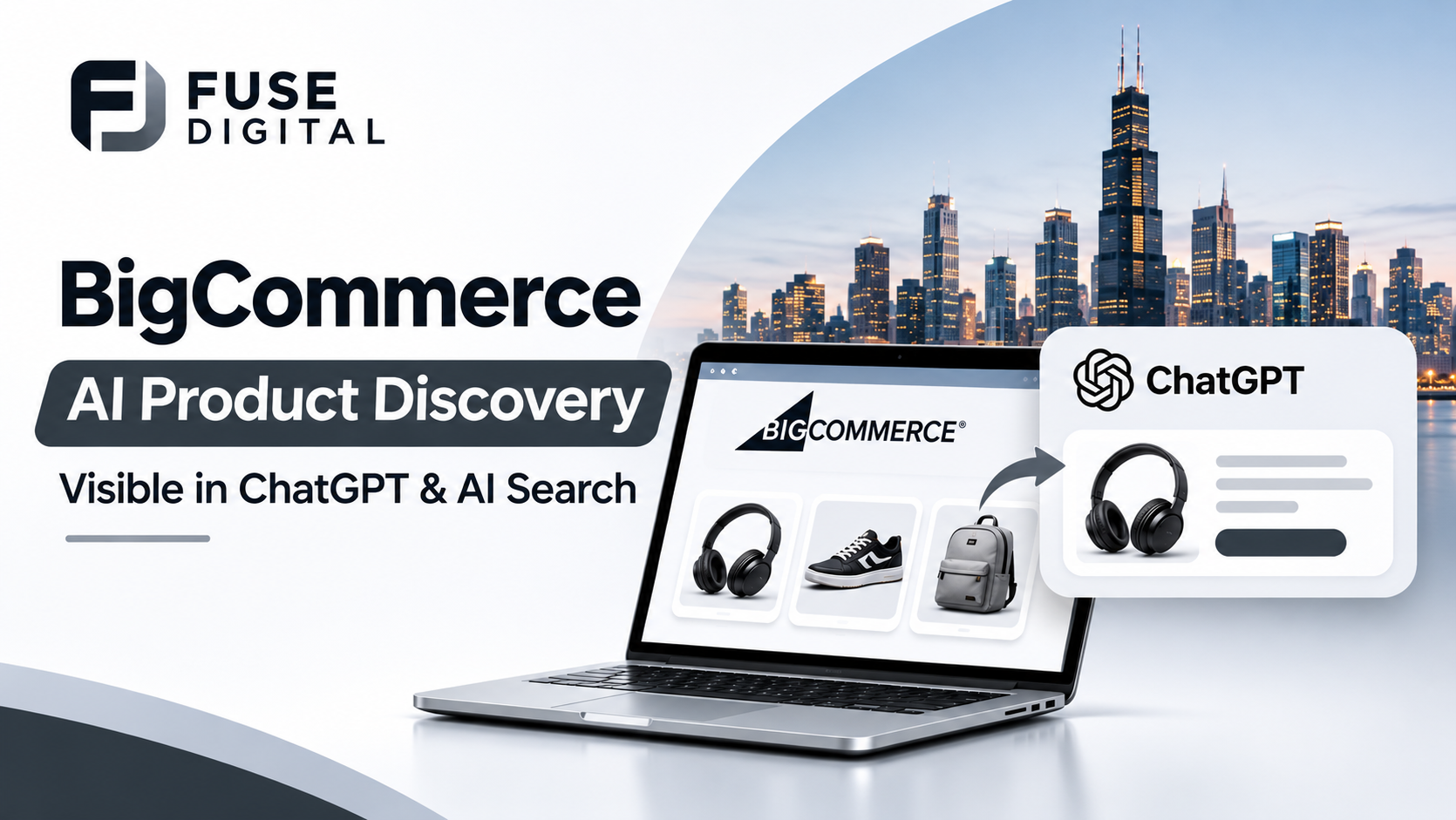
Online shopping is changing fast. Not long ago, customers relied primarily on Google searches, shopping ads, and marketplace listings to find products. Today, more shoppers are turning to AI-powered platforms like ChatGPT, Google AI Overviews, and other conversational search tools to research products, compare options, and make purchasing decisions.
Instead of searching for something as simple as "best wireless headphones," a customer might ask ChatGPT, "Which wireless headphones offer the best noise cancellation under $200?" AI tools can interpret that question, compare available information, and recommend relevant products.
For eCommerce businesses, this shift creates a new opportunity. Your products need to be discoverable not only through traditional search engines but also through AI-powered product discovery experiences.
If your online store runs on BigCommerce, optimizing your product information, structured data, and overall search presence can help improve your visibility across these emerging platforms.
In this guide, we'll explore how BigCommerce businesses can prepare their stores for AI-driven shopping, implement Generative Engine Optimization (GEO), and build a stronger foundation for Answer Engine Optimization (AEO).
1. Understanding AI-Powered Product Discovery
AI-powered product discovery allows shoppers to find products through natural conversations rather than relying entirely on traditional keyword searches.
Customers can ask detailed questions about product features, pricing, materials, use cases, and comparisons. AI platforms then use available information to generate relevant answers and recommendations.
For example, someone shopping for office furniture in Chicago might ask:
"Where can I find an ergonomic office chair with adjustable lumbar support, a breathable mesh back, and a price under $300?"
Rather than simply displaying a list of websites, AI-powered search experiences may summarize relevant product information and direct shoppers toward suitable options.
For BigCommerce merchants, this means product visibility depends on more than ranking for a specific keyword.
Your product pages should clearly communicate:
- What the product is and who it is designed for.
- Its key features, specifications, and benefits.
- Available sizes, colors, materials, and variations.
- Pricing and availability information.
- Shipping, returns, and warranty details.
- Answers to common customer questions.
The more complete and understandable your product information is, the easier it becomes for search engines and AI systems to interpret your offerings.
2. Optimize BigCommerce Product Data for AI Search
Product data is one of the most important foundations of AI product discovery.
AI platforms need reliable information to understand what you're selling and determine whether your products match a shopper's needs.
A product page with a generic description and limited specifications may struggle to communicate its value. On the other hand, a detailed product listing gives search engines and AI systems more useful context.
Here are some practical ways to improve your BigCommerce product data.
Write descriptive product titles
Avoid vague product names that don't explain what the item actually offers.
For example:
- Generic: Office Chair
- Optimized: Ergonomic Office Chair with Adjustable Lumbar Support and Breathable Mesh Back
A descriptive title helps communicate the product category, primary features, and intended use.
Create original product descriptions
Don't rely entirely on manufacturer descriptions. Write unique content that explains what makes each product useful.
Include product benefits, specifications, ideal applications, and important differentiators. Make the information easy to scan and naturally incorporate relevant search terms.
Complete product attributes
Ensure that important product details are available in structured fields wherever applicable.
These may include:
- Brand and manufacturer.
- Product dimensions and weight.
- Material and color.
- Product type and category.
- Model or SKU.
- Pricing and availability.
- Product images and variations.
Complete product information can also support shopping feeds and product integrations.
3. Implement Structured Data to Improve Product Understanding
Structured data helps search engines understand the information published on your website.
For BigCommerce stores, implementing the appropriate Schema.org markup can provide additional context about individual products.
Important schema types include:
- Product Schema: Communicates product information such as name, description, brand, SKU, and image.
- Offer Schema: Provides information about pricing, currency, and product availability.
- AggregateRating Schema: Represents genuine customer ratings and review information when eligible.
- BreadcrumbList Schema: Helps search engines understand the relationship between product categories and individual product pages.
- Organization Schema: Provides information about your business, brand identity, and official website.
For example, a product page selling a leather office chair should clearly communicate its product name, price, availability, brand, and relevant specifications.
Properly implemented structured data can help search engines interpret your content and make eligible pages available for enhanced search experiences.
However, schema markup does not guarantee that a product will appear in ChatGPT recommendations or Google AI Overviews. It is one part of a broader visibility strategy.
4. GEO: Generative Engine Optimization for BigCommerce Stores
Traditional SEO focuses on improving visibility in search engine results. Generative Engine Optimization (GEO) takes this further by preparing website content to be understood, referenced, and potentially surfaced by generative AI platforms.
For eCommerce brands, GEO means making product information useful, accurate, well-organized, and easy to interpret.
Here are several GEO strategies worth implementing.
Create helpful, information-rich product pages
Your product pages should answer real customer questions rather than simply promote a product.
For example, if you sell commercial cleaning equipment, explain where the equipment works best, what problems it solves, and how it compares with alternative solutions.
Publish comparison and buying guide content
AI-powered search often responds to comparison-based questions.
Consider publishing content such as:
- Best Products for Small Business Owners in 2026.
- Product A vs. Product B: Which One Should You Choose?
- How to Choose the Right Equipment for Your Business.
- Important Features to Consider Before Buying.
These articles provide useful context around your product catalog and create additional opportunities to reach customers during the research stage.
Strengthen brand credibility
Build trust through genuine customer reviews, detailed company information, expert insights, case studies, and transparent business policies.
Make sure your brand name, business details, and product information remain consistent across your website and reputable external platforms.
5. AEO: Optimize Your Store for Answer-Based Search
Answer Engine Optimization (AEO) focuses on making your website content easy to understand and useful for answering specific questions.
Customers increasingly use conversational searches instead of short keyword phrases.
For example:
- Which BigCommerce store offers the best products for commercial use?
- What should I look for when buying industrial cleaning equipment?
- Which product is better for a small business?
- How much does this product cost, and is it available?
Your website should provide clear answers to these questions.
Add FAQ sections to important product pages
Include relevant questions about product features, compatibility, usage, shipping, returns, and maintenance.
Use question-based headings
Instead of using generic headings, create sections that directly address customer concerns.
For example:
- What Makes This Product Different?
- Is This Product Suitable for Commercial Use?
- How Do You Maintain This Equipment?
- What Should You Consider Before Purchasing?
Keep answers clear and direct
Provide concise answers first, followed by additional explanations where necessary.
This content structure improves usability and gives search engines clearer information to interpret.
6. Improve Product Visibility Through Google Merchant Center and Shopping Feeds
AI product discovery doesn't replace traditional product discovery channels. Google Shopping, organic search, product feeds, and marketplace integrations remain important parts of an eCommerce strategy.
BigCommerce merchants should pay close attention to their product feed quality.
Google Merchant Center can help eligible products appear across Google's shopping experiences.
Consider these optimization activities:
- Keep product titles and descriptions accurate.
- Use high-quality product images.
- Maintain correct pricing and stock availability.
- Include relevant GTINs, MPNs, and brand information where applicable.
- Resolve product disapprovals and feed errors.
- Keep landing page information consistent with submitted feed data.
Accurate product information across your store and shopping feeds creates a stronger foundation for product discovery.
7. Why Chicago Businesses Need an AI-Focused BigCommerce Strategy
Chicago has a competitive business environment, with companies across retail, manufacturing, distribution, and professional services investing in their digital presence.
For businesses selling online, having a functional eCommerce website is no longer enough. Your products need to be easy to discover, understand, and evaluate.
This is where working with an experienced BigCommerce Development Agency Chicago businesses can rely on becomes valuable.
A well-planned BigCommerce strategy should combine technical development, product data optimization, SEO, and AI search visibility.
Businesses searching for BigCommerce Chicago development services should consider more than website design alone. They should evaluate whether their development partner understands:
- BigCommerce store architecture and customization.
- Technical SEO and website performance.
- Product schema and structured data.
- Product catalog optimization.
- Google Merchant Center integration.
- GEO and AEO implementation.
- Conversion-focused eCommerce development.
Similarly, working with an experienced SEO agency in Chicago businesses can trust can help align traditional organic search strategies with emerging AI discovery opportunities.
Fuse Digital LLC understands the importance of combining eCommerce development with modern search optimization. By bringing together technical expertise, content strategy, and SEO-focused implementation, businesses can build a stronger foundation for long-term online growth.
8. How Fuse Digital LLC Can Help Your BigCommerce Store Prepare for AI Search
Preparing for AI-powered product discovery requires more than adding a few keywords to product descriptions. It involves improving the overall quality, structure, and accessibility of your eCommerce website.
At Fuse Digital LLC, the focus is on helping businesses build and optimize BigCommerce experiences that support both customers and modern search technologies.
Our approach can include:
- BigCommerce Development: Building customized, scalable eCommerce stores that support business goals.
- Technical SEO: Improving website architecture, crawlability, indexing, and performance.
- Product Data Optimization: Improving product titles, descriptions, attributes, and catalog structure.
- Structured Data Implementation: Adding relevant schema markup to help search engines understand website content.
- GEO Strategy: Creating content that supports visibility across generative AI search experiences.
- AEO Optimization: Structuring website content to answer customer questions effectively.
- Google Merchant Center Optimization: Improving product feeds and resolving shopping feed issues.
Whether you're launching a new eCommerce store or improving an existing BigCommerce website, a combined development and SEO strategy can help create more opportunities for customers to discover your products.
Conclusion: Make Your BigCommerce Products Easier to Discover in the AI Era
AI-powered shopping is changing how customers research and discover products online. Platforms like ChatGPT and Google's AI-powered search experiences are creating new ways for shoppers to explore products and evaluate brands.
For BigCommerce merchants, the opportunity is to prepare now by improving product data, implementing structured data, publishing useful content, and investing in GEO and AEO strategies.
There is no guaranteed shortcut to appearing in AI-generated recommendations. However, businesses that provide accurate product information, helpful answers, strong technical foundations, and credible brand experiences will be better positioned as search continues to evolve.
If you're looking to strengthen your eCommerce presence, Fuse Digital LLC can help you bring BigCommerce development and modern SEO strategies together to prepare your online store for the next generation of product discovery.